Products Guide
dbt-contracts uses the Open Data Product Standard (ODPS) v1.0.0 for defining data products. A data product is the higher-level organizational unit that wraps one or more data contracts.
File conventions
- Product files must have the
.odps.yamlextension - Place products in
contracts/products/within your dbt project - Each file defines a single data product
Relationship to contracts
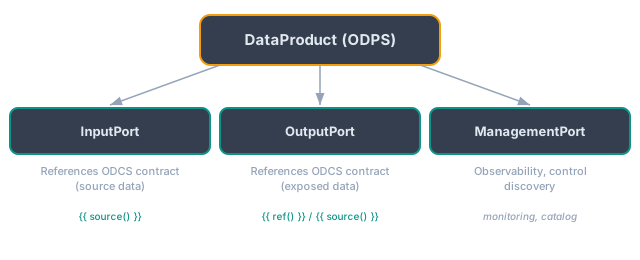
A data product describes what is being delivered and how, while contracts describe the promise about the data itself.
Product structure
A minimal product:
kind: DataProduct
apiVersion: v1.0.0
id: <uuid>
status: active
name: Order Analytics

inputPorts:
  - name: raw-orders
    version: 1.0.0
    contractId: <odcs-contract-uuid>

outputPorts:
  - name: analytics-orders
    version: 1.0.0
    contractId: <odcs-contract-uuid>
Required fields
| Field | Description |
|---|---|
kind |
Must be "DataProduct" |
apiVersion |
Must be "v1.0.0" |
id |
Unique UUID for this product |
status |
One of: proposed, draft, active, deprecated, retired |
Ports
Input ports
Where data comes from. Each input port references an ODCS contract that describes the source data.
Output ports
What the product exposes to consumers. Each output port can reference an ODCS contract.
outputPorts:
  - name: analytics-orders
    version: 1.0.0
    contractId: e4f5a6b7-c8d9-0e1f-2a3b-4c5d6e7f8a9b
    description: Cleaned and enriched order data
    type: table
    inputContracts:
      - 53581432-6c55-4ba2-a65f-72344a91553a
Management ports
Operational interfaces for observability and control.
managementPorts:
  - name: monitoring
    content: observability
    type: rest
    url: https://grafana.example.com/d/orders
  - name: catalog
    content: discoverability
    type: rest
    url: https://catalog.example.com/products/orders
The content field must be one of: discoverability, observability, control, dictionary.
Lineage and dbt generation
ODPS ports determine how contracts are rendered into dbt artifacts:
| Port type | dbt artifact | SQL reference |
|---|---|---|
inputPorts.contractId |
sources.yml |
{{ source() }} |
outputPorts.contractId |
schema.yml + staging SQL |
{{ ref() }} or {{ source() }} |
| Contract not in any port | sources.yml (default) |
{{ source() }} |
When an inputPort references a contract that is also an outputPort of another data product, the staging SQL uses {{ ref() }} instead of {{ source() }} — recognizing it as an intermediate model rather than a raw source.
The outputPorts.inputContracts field defines which upstream contracts a model depends on. This determines the FROM clause in generated staging SQL.
Cross-reference validation
When you run dbt-contracts validate, dbt-contracts checks that all contractId references in your product files resolve to actual ODCS contract files in contracts/contracts/. This can be disabled by setting validation.cross_reference: false in config.
Python model
ODPS files are parsed and validated using the OpenDataProductStandard Pydantic model. This model is hand-rolled from the ODPS v1.0.0 specification, following the same patterns as the official ODCS Python SDK.
Shared types (Team, Support, Description, CustomProperty, AuthoritativeDefinition) are reused directly from the ODCS SDK to ensure consistency between contract and product definitions.
from dbt_contracts.models import OpenDataProductStandard

product = OpenDataProductStandard.from_file("contracts/products/orders.odps.yaml")
print(product.name)
print(product.outputPorts[0].contractId)
See the API reference for the full model definition.
Full example
See the ODPS specification for a comprehensive example with all supported fields.