Architecture
This document describes how dbt-contracts works under the hood.
Overview
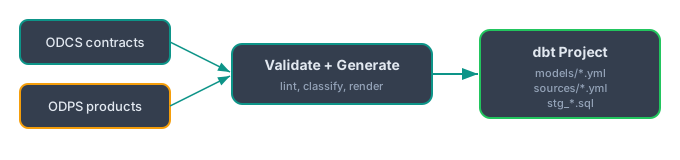
dbt-contracts is a pipeline that reads data contract definitions and produces dbt project artifacts:
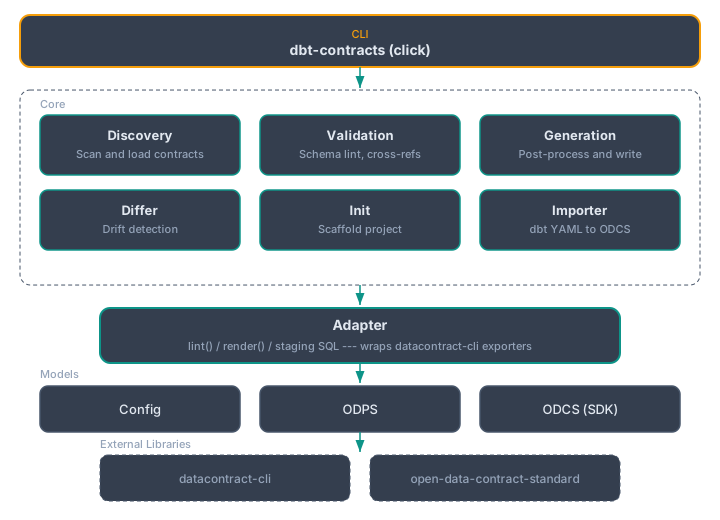
Component architecture
Data flow
1. Discovery
The discovery module scans the contracts/ directory:
contracts/contracts/*.odcs.yaml— loaded via theopen-data-contract-standardSDKcontracts/products/*.odps.yaml— loaded via custom ODPS Pydantic modelscontracts/config.yaml— loaded via custom Config Pydantic model
2. Validation
Validation runs in three passes:
- Schema validation — Each ODCS contract is validated against the JSON schema via the adapter's
lint()function (delegates to datacontract-cli) - Cross-reference validation — All
contractIdfields in ODPS products are checked against loaded ODCS contract IDs (gated byvalidation.cross_referenceconfig) - Status checks — Contract statuses are checked against the
validation.min_statusthreshold
3. Adapter (rendering)
The adapter layer (core/adapter.py) wraps datacontract-cli's dbt exporters and adds lineage awareness:
- Lineage classification — Uses ODPS ports to classify each contract:
outputPorts.contractId→ model (gets model YAML + staging SQL)inputPorts.contractId→ source (gets sources YAML)inputPortsthat are alsooutputPortsof another ODPS → ref (referenced via{{ ref() }}instead of{{ source() }})-
Contracts not in any port → source (default)
-
Per-contract rendering — Calls datacontract-cli's
DbtExporterorDbtSourceExporterper contract, resolving server type from the contract'sserversdefinition -
Staging SQL — Builds SQL referencing upstream contracts. Uses
{{ source() }}for pure sources and{{ ref() }}for contracts that are outputs of other data products
Returns a GenerationResult with parsed dicts for sources, models, and staging SQL strings.
4. Generation
The generator takes the adapter's output and:
| Adapter output | dbt artifact |
|---|---|
result.sources |
sources.yml per source contract |
result.models |
schema.yml per model contract (columns, types, tests, constraints) |
result.staging_sql |
stg_*.sql per model schema object |
The datacontract-cli exporters handle the heavy mapping:
| ODCS | dbt |
|---|---|
| SchemaObject | Model (SQL file + schema.yml entry) |
| SchemaProperty | Column in schema.yml |
| Server | Source in sources.yml |
primaryKey: true |
unique + not_null constraints/tests |
required: true |
not_null constraint/test |
unique: true |
unique constraint/test |
logicalTypeOptions.pattern |
dbt_expectations.expect_column_values_to_match_regex |
logicalTypeOptions.minimum/maximum |
dbt_expectations.expect_column_values_to_be_between |
logicalTypeOptions.minLength/maxLength |
dbt_expectations.expect_column_value_lengths_to_be_between |
relationships |
relationships test |
| Composite primary keys | dbt_utils.unique_combination_of_columns |
description |
description field |
team |
meta.owner field |
5. Diff and sync
The differ (core/differ.py) generates expected output in memory (via a dry-run generate) and compares each file with its on-disk counterpart. Each file is classified as new, modified, or unchanged. The sync command applies detected drift by re-running generation with force=True.
6. Import
The importer (core/importer.py) reads existing dbt schema.yml files and generates ODCS contract stubs. It handles both sources and models definitions, mapping columns, constraints, and data_tests back to ODCS properties.
Standards
dbt-contracts is built on two open standards from the Bitol organization (Linux Foundation AI & Data):
- ODCS v3.1.0 — Defines data contracts (shape, quality, SLAs)
- ODPS v1.0.0 — Defines data products (ports, ownership, governance)
The ODCS SDK (open-data-contract-standard on PyPI) provides Pydantic v2 models for parsing and validating contracts. The ODPS models are hand-rolled following the same methodology. The datacontract-cli library provides dbt export and linting capabilities.